Want to learn how to USE AI technology to make money and/or your life easier? Join our FREE AI community here: https://www.skool.com/ai-with-apex/about
MIT’s New AI Method Could Speed Up the Design of Better Metal Alloys
AI is becoming more useful in materials science when it solves practical bottlenecks instead of just generating more predictions. MIT’s latest work focuses on one of the hardest parts of alloy design: modeling the messy atomic disorder found in real industrial metals.
TL;DR
- MIT researchers developed a machine-learning method to model chemically disordered metal alloys more accurately.
- The approach uses information theory to build smarter training datasets instead of relying on brute-force random sampling.
- The goal is to capture a wider range of local atomic environments that strongly influence alloy behavior.
- MIT says the method improved predictions for properties including stacking-fault energies, short-range order, heat capacities, and phase diagrams across several alloy systems.
- Better simulation tools could help reduce trial-and-error in developing materials for aerospace, energy, and computing.
MIT researchers propose a smarter way to model disordered alloys
What happened
MIT researchers published a new machine-learning method for modeling metal alloys across different compositions, with a focus on chemically disordered materials. Rather than building training datasets through large-scale random sampling, the team used an information-theory-guided approach to select more useful atomic configurations for training.
Why it matters
Real-world alloys are rarely perfectly ordered, and those local atomic differences can have a major impact on material behavior. If simulations miss those hidden patterns, engineers still have to rely heavily on expensive lab testing and manufacturing trials to evaluate promising materials.
Key details
- The MIT News article on the work was published on June 19, 2026. The senior author is Rodrigo Freitas and the first author is Killian Sheriff. The paper is titled Machine learning potentials for modeling alloys across compositions and MIT says it appears in Science Advances.
- The research targets chemical disorder, which MIT describes as a defining feature of most practical metals and alloys used outside idealized lab conditions.
- MIT says conventional methods for generating simulation training data can require more than 100,000 hours of computation for a single material, while still struggling to generalize well across composition changes.
- The new method uses motif-based sampling to reduce redundant examples and expand the diversity of local chemical environments included in the training set.
- According to MIT, this helps the model learn subtle energetic preferences that influence atomic arrangements, phase formation, and resulting material properties.
Source links
https://news.mit.edu/2026/better-way-to-model-metal-alloys-behavior-0619
https://arxiv.org/abs/2506.12592
The advance is really about better training data, not just a bigger model
What happened
Instead of treating alloy modeling as a brute-force compute problem, the MIT team focused on how the training dataset is assembled. Their method identifies when the dataset contains too many similar local atomic environments and replaces redundant samples with missing patterns that better reflect the true diversity of disordered alloys.
Why it matters
That shift matters because model quality often depends as much on data coverage as on model size. In materials science, where atomic arrangements drive performance, training on a broader and more representative set of local environments can produce more physically useful predictions with less wasted computation.
Key details
- The sampling strategy is based on information theory, which the team used to construct datasets that better span the range of local chemical motifs present in disordered materials.
- MIT describes the method as a way to move beyond random sampling and another commonly used sampling method by selecting configurations that expose the model to underrepresented environments.
- The paper reports improved predictions across several material properties, including stacking-fault energies, short-range order, heat capacities, and phase diagrams.
- The alloy systems highlighted in the paper include AuPt, CuAu, CrCoNi, and the high-entropy alloy TiTaVW.
- MIT says the resulting models outperformed models trained with random sampling for the tested alloy-prediction tasks, and it also characterizes the method as outperforming larger models from Google and Microsoft in those benchmarked contexts.
Source links
https://news.mit.edu/2026/better-way-to-model-metal-alloys-behavior-0619
https://arxiv.org/abs/2506.12592
Why better alloy simulations matter to manufacturing
What happened
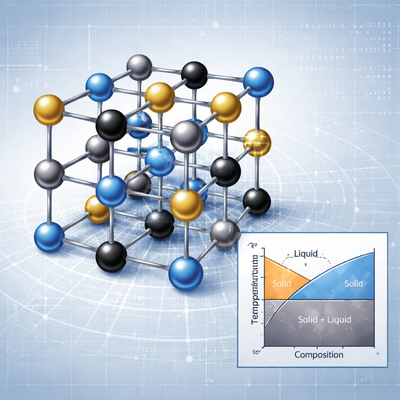
The MIT team frames the work as part of the broader simulation-to-manufacturing pipeline. One of the most important outputs here is better prediction of phase diagrams, which are central tools for understanding how alloys behave under different temperatures and compositions.
Why it matters
Phase diagrams are not just academic charts. They help guide real industrial decisions in processes such as casting, welding, and heat treatment, which means more accurate simulations could eventually make materials development faster, cheaper, and more reliable.
Key details
- MIT explicitly connects improved alloy modeling to industrial workflows in casting, welding, and heat treatment.
- The research is presented as relevant to advanced materials used in aerospace, energy, and computing.
- MIT also points to potential applications in areas such as sustainable steels and other complex alloy systems where local atomic disorder strongly influences performance.
- The advance is a modeling and simulation method, not the invention of a new commercial alloy.
Source links
https://news.mit.edu/2026/better-way-to-model-metal-alloys-behavior-0619
MIT’s result is a useful reminder that progress in AI for science often comes from better representations of the physical world, not just more scale. In this case, smarter sampling of atomic environments could make alloy simulations more practical for the industries that depend on better metals.
---
Want to learn how to USE AI technology to make money and/or your life easier? Join our FREE AI community here: https://www.skool.com/ai-with-apex/about