Want to learn how to USE AI technology to make money and/or your life easier? Join our FREE AI community here: https://www.skool.com/ai-with-apex/about
Enterprise AI Grows Up: Bigger Context, New Leak Risks, and Spend Guardrails
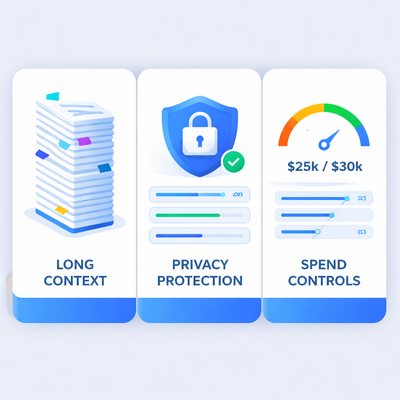
This week’s enterprise AI news points in one direction: model capability is still advancing, but the real market shift is toward control. Longer context windows, safer agents, and tighter admin tooling are becoming part of the same story.
TL;DR
- Subquadratic is drawing attention with claims that its SubQ architecture can support up to 12 million tokens of context while reducing the cost of long-sequence attention.
- The big open question is not whether sub-quadratic attention exists in theory, but whether it delivers reliable performance on real enterprise workloads.
- ServiceNow’s MosaicLeaks benchmark shows that research agents can leak private information through web-query behavior, even when they do not output secrets directly.
- In MosaicLeaks, task-only reinforcement learning improved agent success but also increased leakage, while privacy-aware training reduced leakage sharply with only a small hit to performance.
- OpenAI’s new ChatGPT Enterprise analytics and spend controls show that enterprise AI adoption is moving from experimentation toward budgeted, governed deployment.
Subquadratic says long-context AI may be getting cheaper
What happened
Subquadratic, a startup that emerged from stealth in May, introduced its SubQ model family with a headline claim: sub-quadratic sparse attention that can support very large context windows. Coverage around the launch says the company has discussed research claims of up to 12 million tokens, alongside a smaller production offering around 1 million tokens.
Why it matters
Long context is one of the clearest bottlenecks in large language models because standard transformer attention gets expensive as sequence length grows. If Subquadratic’s approach holds up in practice, it could make document-heavy and code-heavy enterprise workflows cheaper and easier to run at useful scale.
Key details
- SubQ has been described as using sub-quadratic sparse attention to reduce the usual cost growth of long-context inference.
- Launch coverage highlighted claims of up to 12 million tokens in research settings and around 1 million tokens in a production offering.
- The core technical pitch is tied to the well-known problem that standard attention scales quadratically with sequence length, making long windows expensive without architectural changes.
- Independent skepticism remains focused on whether benchmark results will translate into robust reasoning on messy real-world tasks, especially outside controlled retrieval setups.
- The enterprise use cases most often attached to the claim include large document review, codebase-wide agents, and other workflows where context length directly affects usability.
Source links
https://www.eweek.com/news/subquadratic-subq-12m-token-llm-neuron/?utm_source=openai
https://efficienist.com/a-12-million-token-llm-appeared-out-of-nowhere-and-the-ai-community-isnt-sure-what-to-make-of-it/?utm_source=openai
https://arxiv.org/abs/2601.18401?utm_source=openai
ServiceNow’s MosaicLeaks shows how capable agents can expose secrets
What happened
ServiceNow researchers published MosaicLeaks, a benchmark designed to test whether research agents can keep private enterprise information from leaking through their search behavior. The setup combines private local documents with web retrieval and measures whether outside observers could reconstruct sensitive facts from the pattern of outbound queries.
Why it matters
This is a practical enterprise risk because many new AI systems are built as tool-using agents rather than standalone chatbots. MosaicLeaks argues that the privacy surface is not just model output, but also the query trail an agent leaves behind while trying to complete a task.
Key details
- The benchmark introduces three leakage levels: intent leakage, answer leakage, and full-information leakage.
- MosaicLeaks includes 1,001 multi-hop research chains that combine local enterprise documents with a controlled web corpus.
- In the reported results, the base model reached 48.7% strict chain success with 34.0% answer or full-information leakage.
- Task-only reinforcement learning improved success to 59.3% but increased leakage to 51.7%.
- Privacy-aware training reported 58.7% success while reducing leakage to 9.9%.
- The authors also note that prompt-based instructions not to leak helped only slightly and inconsistently compared with privacy-aware rewards during training.
Source links
https://huggingface.co/blog/ServiceNow/mosaicleaks
OpenAI adds enterprise usage analytics and spend controls
What happened
OpenAI announced new analytics and spend-control features for ChatGPT Enterprise on June 18. The update gives administrators more visibility into usage and more ways to set limits across teams and individuals.
Why it matters
This is a clear signal that enterprise AI is becoming an operations problem as much as a model problem. Buyers want the same tools they expect from other software categories: budget controls, adoption visibility, and the ability to manage usage without blanket restrictions.
Key details
- The update adds credit usage analytics in the Global Admin Console for enterprise administrators.
- OpenAI says admins now get unified visibility across ChatGPT and Codex credit usage.
- Usage can be broken down by user, product, and model.
- The same information is also available through a unified Cost API.
- Admins can set workspace defaults, group limits, and individual overrides rather than relying on one universal cap.
- OpenAI has also said enterprise represents more than 40% of revenue and is expected to approach parity with consumer by the end of 2026.
Source links
https://openai.com/index/chatgpt-enterprise-spend-controls
https://openai.com/index/next-phase-of-enterprise-ai/?utm_source=openai
The pattern across all three stories is simple: enterprise AI is no longer just about making systems more capable. The next phase belongs to vendors that can pair more power with stronger privacy discipline, clearer observability, and tighter cost control.
---
Want to learn how to USE AI technology to make money and/or your life easier? Join our FREE AI community here: https://www.skool.com/ai-with-apex/about