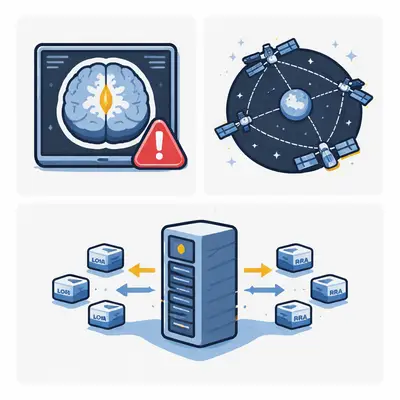
Today’s theme: AI isn’t just getting smarter—it’s getting more operational: triaging hospital imaging, training across satellite constellations, and customizing LLMs without pooling sensitive data.
<h2>TL;DR (5 bullets)</h2>
<ul>
  <li><strong>Healthcare:</strong> University of Michigan’s <strong>Prima</strong> is a vision-language model that reads brain MRIs quickly and can <strong>flag urgent cases</strong> for faster routing to specialists.</li>
  <li><strong>Key numbers:</strong> Reported performance includes <strong>up to 97.5% accuracy</strong> across <strong>50+ diagnoses</strong>, evaluated on <strong>30,000+ MRI studies</strong> over a year (per the report).</li>
  <li><strong>Space ML:</strong> Microsoft Research’s <strong>OrbitalBrain</strong> treats a satellite constellation like a distributed training cluster using <strong>inter-satellite links</strong>.</li>
  <li><strong>Key numbers:</strong> OrbitalBrain reports <strong>1.52×–12.4×</strong> faster “time-to-accuracy” vs baselines (simulation-based).</li>
  <li><strong>Practical:</strong> A federated learning walkthrough shows how to fine-tune LLMs with <strong>Flower + LoRA (PEFT)</strong> by sharing only adapter weights—plus a quick checklist of <strong>7 EDA tricks</strong> to catch data problems early.</li>
</ul>
<h2>1) Healthcare AI: “Prima” reads brain MRIs fast—and triages emergencies</h2>
<p>Most medical imaging AI stories focus on one narrow task (spotting one lesion, one disease, one modality). The more interesting angle here is operational: <strong>AI as a triage and workflow layer</strong> that helps overloaded radiology systems move time-critical cases faster—especially in neuroimaging, where minutes can matter.</p>
<h3>What’s new</h3>
<p>Researchers at the University of Michigan introduced <strong>Prima</strong>, described as a <strong>vision-language model (VLM)</strong> for brain MRI interpretation. In plain English: it combines image understanding with text-based reasoning so it can generate more flexible outputs than a single-purpose classifier—and it can support <strong>urgency prioritization</strong> (for example, routing suspected stroke or hemorrhage cases sooner).</p>
<h3>The numbers worth citing (and verifying in the paper)</h3>
<ul>
<li><strong>Up to 97.5% accuracy</strong> reported across a set of brain MRI diagnostic tasks.</li>
<li>Coverage of <strong>50+ radiologic diagnoses</strong> (positioned as broad rather than single-condition).</li>
<li>Evaluated across <strong>30,000+ MRI studies</strong> over a year in a real-world setting (as described in the report).</li>
</ul>
<h3>Why this matters (beyond the benchmark)</h3>
<p>If systems like Prima hold up across scanner types, protocols, and hospital workflows, the impact isn’t just “AI gets another high score.” The impact is <strong>reducing time-to-care</strong> by helping the right specialist see the right scan sooner. That’s a very different value proposition than “AI replaces radiologists” (which is not what this is).</p>
<h3>What to ask next (the practical skepticism checklist)</h3>
<ul>
<li><strong>Generalization:</strong> How does performance change across different scanners and imaging protocols?</li>
<li><strong>Emergent misses:</strong> What are the <em>false negative</em> rates for time-critical findings?</li>
<li><strong>Explainability:</strong> Does it provide localization (heatmaps) or structured rationale that clinicians can audit?</li>
<li><strong>Workflow integration:</strong> How are alerts routed to teams, and how are alert fatigue and escalation handled?</li>
</ul>
<p><strong>Source:</strong> ScienceDaily summary of the University of Michigan work published in <em>Nature Biomedical Engineering</em> (see the original paper for methodology details and full metrics).</p><h2>2) Space + ML systems: OrbitalBrain trains models in orbit using inter-satellite links</h2>
<p>Earth-observation satellites generate enormous volumes of imagery, but downlink bandwidth is the bottleneck. So here’s the inversion: instead of “collect data in space, train on Earth,” OrbitalBrain pushes toward <strong>training in space</strong>—treating the constellation like a distributed machine learning system.</p>
<h3>What OrbitalBrain is</h3>
<p><strong>OrbitalBrain</strong> (Microsoft Research) is a distributed framework that coordinates three levers:</p>
<ul>
<li><strong>Local compute (LC):</strong> train on each satellite’s onboard hardware.</li>
<li><strong>Model aggregation (MA):</strong> share and merge model updates over <strong>inter-satellite links</strong>.</li>
<li><strong>Data transfer (DT):</strong> selectively move raw samples between satellites to reduce data skew when it’s worth it.</li>
</ul>
<h3>The headline result</h3>
<p>Microsoft reports <strong>1.52×–12.4× speedup</strong> in “time-to-accuracy” compared to baseline strategies, while reaching <strong>higher final accuracy</strong> in their evaluated scenarios.</p>
<h3>What makes this a “systems” story (not just an ML story)</h3>
<p>The novelty isn’t a new architecture like a better ResNet—it’s <strong>resource-aware orchestration</strong> under orbital constraints: intermittent connectivity, limited onboard compute, and constantly changing topology.</p>
<h3>Implementation details that ground the story</h3>
<ul>
<li>Evaluated in simulation using <strong>CosmicBeats</strong> (orbital simulator) plus <strong>FLUTE</strong> (federated learning framework).</li>
<li>Onboard compute modeled after <strong>NVIDIA Jetson Orin Nano 4GB</strong>.</li>
<li>Constellation scenarios include references to <strong>Planet</strong> and <strong>Spire</strong>.</li>
<li>Datasets/tasks mentioned include <strong>fMoW</strong> and <strong>So2Sat</strong> with partial fine-tuning of standard vision backbones.</li>
</ul>
<h3>How to frame it for readers</h3>
<p>Think of it as moving from <strong>“download then train”</strong> to <strong>“train-then-download (or aggregate)”</strong>. For time-sensitive use cases—wildfire detection, flood mapping, disaster response—the latency savings can be more important than squeezing out an extra percent of accuracy.</p>
<p><strong>Caution:</strong> Many results are <strong>simulation-based</strong>. The right follow-up question is: what changes (and what breaks) in real on-orbit deployments?</p>
<p><strong>Primary source:</strong> Microsoft Research publication page for “OrbitalBrain: A Distributed Framework for Training ML Models in Space.”</p><h2>3) Federated LoRA fine-tuning: customizing LLMs without centralizing sensitive text</h2>
<p>Organizations want models that speak their language—policies, product docs, internal workflows—but they often can’t centralize data. A practical pattern is emerging: <strong>federated learning + parameter-efficient fine-tuning (PEFT)</strong>, especially <strong>LoRA adapters</strong>.</p>
<h3>What the walkthrough demonstrates</h3>
<p>A tutorial shows how to simulate multiple clients (think: organizations or departments). Each client fine-tunes locally and shares only <strong>LoRA adapter weights</strong>—not raw text—using the <strong>Flower</strong> federated learning framework and Hugging Face tooling.</p>
<h3>Details that make it implementable</h3>
<ul>
<li>Frameworks: <strong>Flower</strong> (<code>flwr[simulation]</code>), <strong>Transformers</strong>, <strong>PEFT</strong>, <strong>Accelerate</strong>, <strong>Datasets</strong> (optional <code>bitsandbytes</code> for GPU efficiency).</li>
<li>Example models: <code>TinyLlama/TinyLlama-1.1B-Chat-v1.0</code> (GPU) or <code>distilgpt2</code> (CPU).</li>
<li>Example setup: <strong>3 clients</strong>, <strong>3 rounds</strong>.</li>
<li>Only adapter parameters are exchanged by filtering state dict keys containing <code>"lora_"</code>.</li>
</ul>
<h3>The nuance worth adding (so readers don’t get misled)</h3>
<p>“Federated” doesn’t automatically mean “private.” Not sending raw text helps, but model updates can still leak information in some settings. If you’re doing this for real, the next step is usually one (or more) of:</p>
<ul>
<li><strong>Secure aggregation</strong> (so the server can’t inspect individual updates)</li>
<li><strong>Differential privacy</strong> (to reduce memorization and leakage risk)</li>
<li><strong>Careful evaluation</strong> against extraction / membership inference risks</li>
</ul>
<p><strong>Source:</strong> MarkTechPost tutorial (useful as a hands-on starting point) and the PEFT LoRA documentation for concept grounding.</p><h2>4) The working programmer corner: 7 fast EDA checks that prevent silent failures</h2>
<p>Not every AI failure starts with a model. Many start with a dataset that <em>looks</em> fine until it quietly corrupts training. A KDnuggets walkthrough offers a handy “early warning” checklist you can run in minutes.</p>
<h3>7 EDA tricks (quick checklist)</h3>
<ol>
<li><strong>Missing values:</strong> <code>df.isnull()</code> + a seaborn heatmap to spot patterns.</li>
<li><strong>Duplicates:</strong> <code>df.duplicated()</code> and <code>drop_duplicates()</code>.</li>
<li><strong>Outliers:</strong> IQR-based detection; optionally cap with <code>clip()</code>.</li>
<li><strong>Category hygiene:</strong> normalize strings with <code>str.strip().str.lower()</code> and targeted replacements.</li>
<li><strong>Range validation:</strong> detect impossible values (like negative ages) and convert to NaN for handling.</li>
<li><strong>Skew:</strong> use <code>log1p</code> when distributions are heavily right-tailed.</li>
<li><strong>Redundant features:</strong> correlation heatmaps and top correlated pairs to reduce leakage and multicollinearity.</li>
</ol>
<p>It’s not glamorous, but it’s high ROI: EDA is <strong>risk reduction</strong>—catching broken joins, drift, and leakage before the model “learns” the wrong reality.</p>
<p><strong>Source:</strong> KDnuggets (EDA tricks article).</p><h2>Quick links (optional reads)</h2>
<ul>
<li><strong>Python automation scripts</strong> for repetitive file tasks (organizers, batch renamers, backups, duplicate finders).</li>
<li><strong>Claude Code workflow tips</strong> (contexting files, plan-first changes, extended thinking for debugging/optimization)—useful even if you apply the pattern with other agentic coding tools.</li>
</ul><h2>One unifying takeaway</h2>
<p>The most interesting AI progress right now is less about “one more benchmark win” and more about <strong>deployable systems under constraints</strong>:</p>
<ul>
<li>In hospitals: reduce time-to-specialist by triaging imaging.</li>
<li>In orbit: reduce time-to-accuracy by training where the data is produced.</li>
<li>In enterprises: adapt LLMs while keeping data where it must stay.</li>
</ul>
<p>If you want, I can turn this into a tighter “newsletter-style” version (shorter sections, more punchy transitions) or expand any one story into a deeper reported piece with a verification checklist.</p>