Want to learn how to USE AI technology to make money and/or your life easier? Join our FREE AI community here: https://www.skool.com/ai-with-apex/about
AI’s Next Phase: Science, Enterprise Agents, and the Rules Taking Shape
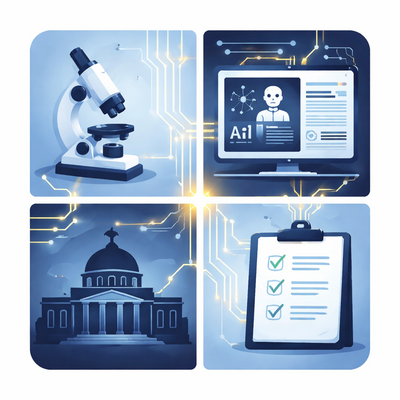
Today’s AI news is less about flashy demos and more about where these systems are actually landing: research labs, enterprise workflows, public institutions, and the standards bodies that may shape what comes next.
The common thread is simple: AI is moving from novelty to infrastructure, and that changes the conversation from capability alone to deployment, accountability, and usefulness.
TL;DR
- MIT’s 2026 AI and Society Forum focused on how AI is affecting work, civil discourse, and election administration, with an emphasis on keeping humans accountable in decision-making.
- OpenAI highlighted a case in which GPT-5 Pro helped an immunologist generate a plausible explanation and follow-up experiments for a long-running T-cell puzzle.
- IBM Research’s CUGA framework reflects a broader push to make AI agents more configurable and usable in enterprise settings.
- OpenAI’s broader 2026 governance activity shows standards, safety frameworks, and interoperability becoming a more strategic part of the AI stack.
- Across all four stories, the competitive edge is shifting from raw model intelligence to reliability, institutional fit, and human oversight.
MIT Says AI’s Biggest Disruption May Be Institutional, Not Just Technical
What happened
MIT used its 2026 AI and Society Forum to spotlight a different kind of AI story: not just what models can do, but what happens when they start shaping work, democracy, and public life. The forum centered on AI’s effects on employment, automation, civil discourse, and election administration, with MIT researchers arguing that human judgment must remain central even in increasingly automated systems.
Why it matters
This is a strong signal that leading research institutions are moving the debate beyond benchmarks and product launches. The harder questions now involve governance, accountability, and how AI changes institutions once it leaves the lab and enters workplaces and civic systems.
Key details
- MIT’s forum examined AI’s impact on employment, automation, civil discourse, and election administration.
- Daniela Rus emphasized that humans should remain the decision-makers in AI-supported workflows.
- The event framed AI as a social and institutional force, not only a technical one.
- The discussion highlighted second-order effects such as job redesign, public trust, and democratic resilience.
Source links
https://news.mit.edu/2026/exploring-societal-impacts-of-ai-0623
OpenAI’s GPT-5 Pro Case Study Points to AI as a Lab-Side Reasoning Partner
What happened
OpenAI published research materials describing how immunologist Derya Unutmaz used GPT-5 Pro to analyze an unresolved T-cell experiment involving 2-deoxy-D-glucose (2-DG). In that account, the model proposed a mechanism that could explain why treatment increased a pro-inflammatory Th17 cell subset and suggested follow-up experiments to test the idea.
Why it matters
This is one of the clearest current examples of AI being framed as a scientific collaborator rather than a simple summarization tool. The value proposition is not that the model replaces the scientist, but that it can help generate mechanisms, narrow hypotheses, and reduce wasted experimental cycles.
Key details
- In OpenAI’s Early science acceleration experiments with GPT-5 document, Unutmaz says GPT-5 Pro analyzed prior human T-cell data involving 2-DG and proposed a mechanistic explanation.
- The account describes model-generated hypotheses involving glycosylation, IL-2 receptor pathway effects, and differences between memory and naïve T cells.
- Unutmaz also says the model interpreted unpublished checkpoint data involving PD-1 and LAG-3.
- The same document says GPT-5 Pro correctly predicted that transient 2-DG exposure during CAR-T generation could improve cytotoxic performance, which Unutmaz describes as internally validated.
- Unutmaz characterizes the system’s role as approaching “co-investigator level” for hypothesis generation and experiment planning.
- This remains a company-backed case study and includes unpublished findings, so it is best read as a promising example rather than a definitive peer-reviewed resolution.
Source links
https://cdn.openai.com/pdf/4a25f921-e4e0-479a-9b38-5367b47e8fd0/early-science-acceleration-experiments-with-gpt-5.pdf?curius=526
https://openai.com/index/introducing-new-capabilities-to-gpt-rosalind/?utm_source=openai
IBM Research’s CUGA Shows the Agent Race Turning Into an Infrastructure Race
What happened
IBM Research’s work around CUGA, short for Configurable Generalist Agent, is aimed at making AI agents more practical for real deployments. The Hugging Face write-up presents CUGA as an open-source agent framework designed to improve configurability, reliability, and ease of use for enterprise scenarios, with integrations that include Hugging Face Spaces, Langflow, and GitHub.
Why it matters
The industry’s focus is shifting from whether a model can answer a prompt to whether an agent can execute repeatable workflows inside an organization. That makes orchestration, configuration, benchmarking, and deployment patterns more important than another isolated demo.
Key details
- IBM Research describes CUGA as a configurable open-source AI agent for enterprise use cases.
- The framework is intended to reduce brittleness and orchestration complexity in agent systems.
- The Hugging Face post highlights integrations with Hugging Face Spaces and Langflow, along with a public GitHub repository.
- The associated Hugging Face materials describe CUGA as a leader on the AppWorld Benchmark.
- The main Hugging Face article was published in December 2025, while also pointing readers to newer June 2026 IBM materials built around the same framework.
Source links
https://huggingface.co/blog/ibm-research/cuga-on-hugging-face
Standards and Governance Are Becoming a Competitive Layer of AI
What happened
OpenAI is being reported as supporting shared standards for advanced AI through the Appia Foundation, though the specific original OpenAI page for that item was not directly surfaced during research. What is clear from OpenAI’s official materials is that the company has been steadily expanding its 2026 work around governance, safety frameworks, provenance, and interoperability.
Why it matters
The standards layer is starting to matter almost as much as the model layer itself. The organizations that help define evaluations, safety language, provenance systems, and agent interoperability can influence how the next generation of AI products is measured, trusted, and regulated.
Key details
- OpenAI published a public policy agenda on June 3, 2026 focused on safety and democratic deployment.
- OpenAI also published a blueprint for democratic governance of frontier AI on June 3, 2026.
- Its Frontier Governance Framework, published May 28, 2026, connects internal safety practices to emerging legal and regulatory regimes.
- OpenAI published work on advancing content provenance on May 19, 2026, including support for C2PA-related efforts.
- OpenAI has also backed interoperable agent standards through the Agentic AI Foundation under the Linux Foundation.
- The reported Appia-related move fits this broader pattern, even if the exact original post was not directly available here.
Source links
https://vff.ai/article/2026/06/24/helping-build-shared-standards-for-advanced-ai
https://openai.com/index/public-policy-agenda/?utm_source=openai
https://openai.com/index/frontier-safety-blueprint/?utm_source=openai
https://openai.com/index/openai-frontier-governance-framework/?utm_source=openai
https://openai.com/index/advancing-content-provenance/?utm_source=openai
https://openai.com/index/agentic-ai-foundation/?utm_source=openai
Put together, today’s stories show an AI industry entering a more institutional phase. The big question is no longer just how smart the systems are, but how well they fit into science, business, and public life without losing human accountability along the way.
---
Want to learn how to USE AI technology to make money and/or your life easier? Join our FREE AI community here: https://www.skool.com/ai-with-apex/about