Want to learn how to USE AI technology to make money and/or your life easier? Join our FREE AI community here: https://www.skool.com/ai-with-apex/about
AI’s Next Bottlenecks: Cooling, Robotics, and the Cost of Outsourcing Judgment
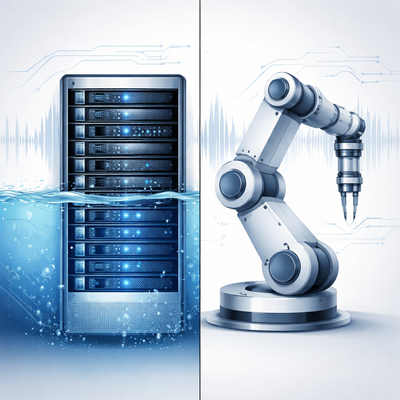
Today’s AI story is bigger than model releases. The most interesting developments are happening around the models: in the data centers that power them, the robots that may deploy them in the physical world, and the human skills that may weaken as AI gets more capable.
TL;DR
- MIT researchers found that AI fact-checking improved headline evaluation in the moment, but participants performed worse on their own after relying on the tool over time.
- MIT startup Ferveret is applying nuclear-inspired liquid cooling to data centers, targeting one of AI infrastructure’s biggest physical constraints: heat.
- Google DeepMind launched a three-month robotics accelerator in Europe, signaling a push to shape the startup layer of embodied AI.
- DeepMind is also pushing real-time speech translation with Gemini 3.5 Live Translate, though the company notes clear limitations in long and multi-speaker sessions.
- Smaller, more deployable models are gaining ground, with Gemma 4 aimed at local multimodal workloads and Cohere’s North Mini Code targeting agentic coding tasks.
MIT says AI fact-checking can weaken people’s own misinformation defenses
What happened
MIT Media Lab published a study examining what happens when people rely on AI to judge whether news content is real or fake. The researchers found that AI assistance helped participants perform better while the tool was available, but participants became worse at spotting misinformation on their own after sustained reliance.
Why it matters
This is a useful counterweight to the usual “AI improves information quality” narrative. The study suggests that some AI tools may operate like GPS for cognition: helpful in the short term, but capable of eroding the skill they are replacing.
Key details
- The study was published on June 9, 2026 by MIT Media Lab.
- Researchers tracked 67 participants over four weeks as they evaluated headline-image pairs.
- With AI chatbot assistance, participants were 21% more accurate at identifying fake news.
- After a month of relying on the AI, participants performed worse when the chatbot was removed.
- MIT compares the effect to how GPS can weaken navigation skills over time.
- The MIT report also notes that one in five U.S. teens regularly use LLMs for news, and one in four young adults have used them for that purpose at least once.
Source links
https://news.mit.edu/2026/consequences-of-relying-on-ai-for-accurate-news-0609?utm_source=openai
Ferveret wants to cool AI data centers with nuclear-inspired liquid immersion
What happened
MIT News highlighted Ferveret, a startup founded by MIT Associate Professor Matteo Bucci and former MIT postdoc Reza Azizian. The company is developing a cooling system that submerges servers in a specialized liquid designed to absorb heat more efficiently than air.
Why it matters
As AI workloads grow, compute is no longer just a software story. Power delivery, heat dissipation, and physical density are becoming strategic constraints, which makes cooling technology an increasingly important part of the AI stack.
Key details
- MIT News reports that Ferveret was founded by Matteo Bucci and Reza Azizian.
- The company’s system immerses computer servers in a liquid coolant instead of relying on conventional air cooling.
- MIT frames the approach as “nuclear-inspired,” borrowing thermal-management ideas developed for more extreme environments.
- OpenAI said in April 2026 that it had already surpassed its earlier 10GW-by-2029 U.S. infrastructure milestone and added more than 3GW in the prior 90 days, underscoring the scale of AI infrastructure demand.
Source links
https://news.mit.edu/2026/nuclear-inspired-cooling-system-ferveret-could-make-data-centers-more-sustainable-0610?utm_source=openai
https://openai.com/index/building-the-compute-infrastructure-for-the-intelligence-age/?utm_source=openai
Google DeepMind launches a robotics accelerator in Europe
What happened
Google DeepMind launched a three-month accelerator for robotics startups across Europe. The program includes a five-day in-person kickoff in London in June 2026 and gives founders access to technical mentorship, product guidance, partner networks, and DeepMind’s robotics-related AI tools.
Why it matters
This is less about one new robotics model and more about ecosystem control. DeepMind is trying to build relationships with the companies that could turn foundation-model capabilities into physical products across industry, healthcare, construction, and other real-world environments.
Key details
- The accelerator runs for three months and is focused on European robotics startups.
- The program begins with a five-day in-person kickoff in London in June 2026.
- DeepMind says participants receive technical mentorship, product guidance, partner access, and support tied to its robotics AI stack.
- The startup cohort spans areas including robotic welding, industrial physical AI, quality assurance, construction microfactories, ocean robotics, waste sorting, teleoperation, predictive maintenance, neurosurgical microrobots, and tactile sensing.
Source links
https://deepmind.google/models/gemini-robotics/accelerator/?utm_source=openai
Gemini 3.5 Live Translate pushes closer to real-time voice-to-voice translation
What happened
Google DeepMind detailed Gemini 3.5 Live Translate as a real-time speech-to-speech translation system. The company is positioning it across AI Studio, Google Translate, and Google Meet, with a focus on preserving more of the original speaker’s delivery instead of only translating the words.
Why it matters
Translation is moving beyond text conversion and subtitles into live conversation. That raises the bar from semantic accuracy to something more demanding: low latency, natural speech, and a translated voice that still feels like the original speaker.
Key details
- DeepMind says Gemini 3.5 Live Translate supports 70+ languages and 2,000 language pairs.
- The model card says it was evaluated on translation quality, latency, and speech naturalness.
- The system supports audio input with a 128K token context window and audio or text output up to 64K tokens.
- DeepMind says the model is designed to preserve intonation, pacing, and pitch.
- The company also notes limitations, including inconsistent voices, shifts after long pauses, gender changes, and failures during rapid multi-speaker sessions.
Source links
https://deepmind.google/models/gemini-audio/?utm_source=openai
https://deepmind.google/models/model-cards/gemini-3-5-audio/?utm_source=openai
https://deepmind.google/models/gemini-audio/live-dialogue/?utm_source=openai
Gemma 4 shows how multimodal AI is moving onto smaller hardware
What happened
Google DeepMind is pushing Gemma 4 as a more efficient model family for developers who want multimodal capability without depending entirely on large cloud deployments. The company describes Gemma 4 12B as a unified, encoder-free multimodal model and positions the broader family for local and workstation-class use.
Why it matters
The competitive edge in AI is no longer only about scale. Smaller models that can run on consumer GPUs or local systems matter for privacy, latency, cost control, and offline workflows.
Key details
- DeepMind describes Gemma 4 12B as a “unified, encoder-free multimodal model.”
- The Gemma 4 family includes 12B, 26B, and 31B variants.
- DeepMind says the family is designed for agentic workflows, multimodal reasoning, and multilingual use.
- The company says Gemma 4 supports 140 languages across the family.
- DeepMind highlights deployment on consumer GPUs, while smaller Gemma variants are positioned for phones, Raspberry Pi, and Jetson Nano class devices.
Source links
https://deepmind.google/models/gemma/?utm_source=openai
https://deepmind.google/models/gemma/gemma-4/?utm_source=openai
Cohere Labs releases North Mini Code for agentic software engineering
What happened
Cohere Labs introduced North Mini Code, an open coding model aimed at more than autocomplete. The release is tuned for multi-step software engineering tasks in terminals and agent harnesses, which reflects the shift from coding assistants toward coding agents.
Why it matters
The coding-model race is moving toward models that can operate reliably inside real workflows. Open licensing and smaller active parameter counts also make these systems easier to test, integrate, and deploy commercially.
Key details
- North Mini Code was introduced on June 9, 2026.
- Cohere describes it as a 30B-parameter Mixture-of-Experts model with 3B active parameters.
- The model is released under the Apache 2.0 license.
- Cohere says it is optimized for complex software engineering workflows, terminal-based agentic tasks, and code generation.
- The company says availability includes the Cohere API, OpenCode, and Hugging Face, with BF16 and FP8 weights.
Source links
https://huggingface.co/blog/CohereLabs/introducing-north-mini-code?utm_source=openai
OpenAI uses Nextdoor to highlight the rise of coding agents inside enterprises
What happened
OpenAI published a customer case study on Nextdoor, using it to illustrate how coding agents are moving into day-to-day engineering work. According to OpenAI, Nextdoor’s team uses Codex with GPT-5.5 to investigate difficult issues and help engineers work more end-to-end across systems.
Why it matters
Vendor case studies are not independent audits, but they are useful signals of where enterprise adoption is heading. The theme here is that companies are shifting from experimenting with chat interfaces to redesigning workflows around AI systems that can execute technical tasks.
Key details
- OpenAI says Nextdoor’s engineering organization uses Codex with GPT-5.5 to investigate hard-to-reproduce issues.
- OpenAI says Nextdoor serves 110 million users across 11 countries.
- The case study frames the workflow shift as moving from repeated prompting to “outcome engineering.”
- OpenAI separately says GPT-5.5 is rolling out in ChatGPT and Codex with emphasis on agentic coding, computer use, and knowledge work.
Source links
https://openai.com/index/nextdoor/?utm_source=openai
https://openai.com/index/introducing-gpt-5-5/?utm_source=openai
Put together, today’s stories point to an AI industry that is becoming more physical, more embedded, and more operational. The frontier is no longer just what models can say, but how they are cooled, where they run, what systems they control, and what human skills they may quietly displace.
---
Want to learn how to USE AI technology to make money and/or your life easier? Join our FREE AI community here: https://www.skool.com/ai-with-apex/about