Want to learn how to USE AI technology to make money and/or your life easier? Join our FREE AI community here: https://www.skool.com/ai-with-apex/about
AI Moves Into the Real World: UK Housing, MIT Manufacturing, Earth Planning, and Robot Memory
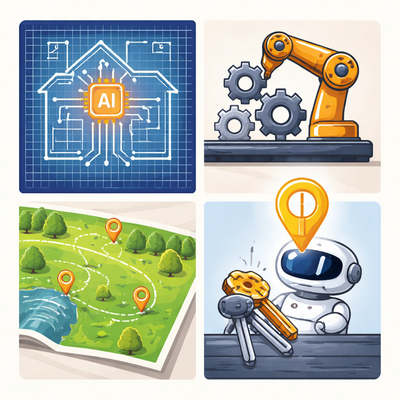
Today’s AI story is less about chatbots and more about infrastructure. The biggest developments are landing in government workflows, factory systems, ecological planning, and robotics that can remember the world around them.
TL;DR
- Google DeepMind says a new AI planning assistant could cut decision times by 50% for some UK householder applications.
- MIT’s manufacturing initiative says it has expanded across research, workforce development, and industry collaboration, with more than 800 registrants at its first Manufacturing Week anniversary programming.
- MIT researchers introduced DAAAM, a robot memory system designed to answer natural-language questions about objects and locations it has seen before.
- Google Research published an Earth AI framework aimed at turning fine-scale land detection into planning-ready data for restoration and carbon accounting.
- Z.ai’s GLM-5 release shows the open-model race is still scaling hard, with the company claiming a 744B-parameter MoE model focused on long-horizon agentic tasks.
Google DeepMind targets UK planning delays with an AI assistant
What happened
Google DeepMind says it is working with the UK government, Google Cloud, Faculty, and local authorities in Barnet, Dorset, and Camden on an AI-powered planning assistant for planning officers. The stated goal is to cut decision times by 50% for certain householder planning cases while keeping the officer as the final decision-maker.
Why it matters
This is one of the clearest examples of generative AI moving into public administration rather than consumer software. If it works as described, it could reduce paperwork bottlenecks in a part of the housing pipeline that affects a large share of planning applications.
Key details
- The UK government’s broader target is 1.5 million new homes by 2029.
- DeepMind says householder applications account for nearly 70% of planning applications each year.
- The prototype is designed to consolidate data, identify relevant policies, summarize consultation feedback, and draft first-pass assessments and conditions.
- The work follows the launch of Extract, a Gemini-based tool built with the UK government’s Incubator for AI to help digitize old planning documents.
- Following early trials, the UK government says it plans to make the tool available to councils nationally from 2027.
Source links
https://deepmind.google/blog/unlocking-uk-house-building-with-ai-accelerated-planning/?utm_source=openai
MIT’s manufacturing initiative shifts AI closer to the factory floor
What happened
MIT says its Initiative for New Manufacturing has grown significantly in its first year across research, workforce development, entrepreneurship, and industry engagement. The institute used its first Manufacturing Week anniversary programming to showcase that push.
Why it matters
The important signal here is institutional, not flashy: MIT is trying to connect research, industrial adoption, startup formation, and worker training in one pipeline. That reflects a broader shift toward AI as part of manufacturing competitiveness and deployment infrastructure.
Key details
- MIT says the anniversary Manufacturing Week programming drew more than 800 registrants, including students, faculty, industry leaders, investors, entrepreneurs, and government officials.
- The initiative was launched to connect research, industry, workforce training, and entrepreneurship.
- MIT says it issued a call for proposals on AI and automation and funded eight seed research projects.
- The institute says it plans to publish eight white papers in June as part of a broader study on the future of manufacturing.
Source links
https://news.mit.edu/2026/mit-initiative-for-new-manufacturing-builds-momentum-0616?utm_source=openai
MIT’s DAAAM gives robots a longer memory
What happened
MIT researchers unveiled DAAAM, a long-term memory framework that helps a robot remember objects it has seen and answer natural-language questions about them later. The core idea is straightforward: a robot should not just describe what it sees now, but also retrieve what it saw before and where it was.
Why it matters
That kind of persistent memory is a missing layer in many embodied AI systems. For home robots, warehouse systems, and other real-world machines, recall can matter as much as perception.
Key details
- MIT says DAAAM combines advanced map representations with rich environmental descriptions.
- The system is designed to answer complex queries in plain language about the robot’s environment.
- To improve efficiency, the framework aggregates nearby objects while traveling, selects key frames to annotate, and stores rich descriptions tied to location.
- MIT frames it as a way for robots to recall both detailed object descriptions and precise locational information.
Source links
https://news.mit.edu/2026/could-ai-tell-you-where-you-left-your-keys-0617?utm_source=openai
Google Research pushes Earth AI from detection to planning
What happened
Google Research published a high-resolution deep learning framework for identifying fine-scale ecological features on working lands, including hedgerows and copses that can be missed by standard satellite detection. The company frames the work as a shift from image recognition toward planning-ready vector data.
Why it matters
This is a useful marker for where climate and land-use AI is heading: not just spotting features from space, but generating outputs that can support restoration planning, biodiversity work, and carbon accounting. The planning layer is what makes the mapping operational.
Key details
- Google describes the project as moving “from pixels to planning”.
- The framework focuses on ecological features that matter for biodiversity, carbon sequestration, and landscape restoration.
- Google says better mapping of these small features could help advance climate and biodiversity goals without compromising food security.
- The output is intended to support restoration planning and carbon accounting, not just detection.
Source links
https://research.google/blog/from-pixels-to-planning-earth-ai-for-nature-restoration/?utm_source=openai
GLM-5 shows open models are still chasing scale and agentic performance
What happened
Z.ai’s GLM-5 landed on Hugging Face as a large open model focused on complex systems engineering and long-horizon agentic tasks. The release is pitched around scale, efficiency, and post-training infrastructure rather than simple chatbot positioning.
Why it matters
The open-model race is still moving aggressively, but the emphasis is shifting. Model builders are now selling long-context performance, sparse efficiency, and tool-using workflows as much as raw size.
Key details
- According to the Hugging Face model page, GLM-5 scales from 355B total parameters / 32B active in GLM-4.5 to 744B total parameters / 40B active in GLM-5.
- Z.ai says pretraining data increased from 23T to 28.5T tokens.
- The model uses a Mixture-of-Experts setup with sparse activation.
- Z.ai says GLM-5 integrates DeepSeek Sparse Attention (DSA) to reduce deployment cost while preserving long-context capacity.
- The company also says it built a new asynchronous RL infrastructure called slime to improve post-training throughput and efficiency.
Source links
https://huggingface.co/zai-org/GLM-5?utm_source=openai
LeRobot points to a more practical open robotics stack
What happened
Hugging Face’s LeRobot project continues to expand from software tooling toward hardware integration. Recent documentation shows support for a bring-your-own-hardware path that lets developers connect their own robots, cameras, and teleoperation devices through installable Python packages.
Why it matters
Robotics has long been fragmented across datasets, control software, simulation, and hardware. LeRobot’s direction suggests open tooling is trying to make that stack more modular and easier to move from the hub to real machines.
Key details
- Hugging Face documents a “Bring Your Own Hardware” integration path for LeRobot.
- The project is positioned as an ecosystem for imitation learning, reinforcement learning, simulation, data collection, training, and hardware integration.
- The LeRobot v0.5.0 release added broader support across robot arms, mobile robots, a humanoid platform, Hub-based environment loading, and IsaacLab-Arena integration.
Source links
https://huggingface.co/docs/lerobot/integrate_hardware?utm_source=openai
https://huggingface.co/docs/lerobot/main/en/index?utm_source=openai
https://huggingface.co/blog/lerobot-release-v050?utm_source=openai
The throughline today is simple: AI is being wired into systems that have rules, places, and physical constraints. Whether the setting is a planning office, a factory, a landscape, or a robot moving through a room, the story is increasingly about making AI useful inside the machinery of the real world.
---
Want to learn how to USE AI technology to make money and/or your life easier? Join our FREE AI community here: https://www.skool.com/ai-with-apex/about