Want to learn how to USE AI technology to make money and/or your life easier? Join our FREE AI community here: https://www.skool.com/ai-with-apex/about
AI Gets More Useful, More Embedded, and More Consequential
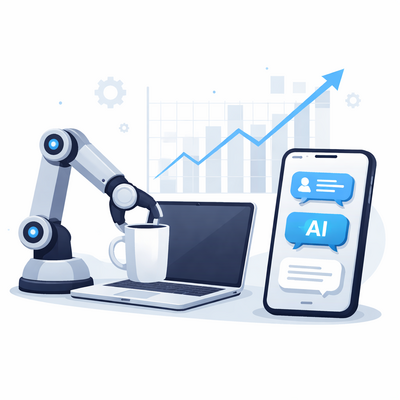
Today’s AI news points in three directions at once: smarter robots in the physical world, faster AI running directly on phones, and sharper attention on what all of this means for work and institutions.
The common thread is maturity. The story is no longer just bigger models. It is about how AI interprets intent, where it runs, and how society prepares for its effects.
TL;DR
- MIT CSAIL unveiled a robotics system that uses large language models to help robots interpret vague human instructions more effectively.
- MIT says the method used nearly five times less demonstration data and identified unstated user preferences up to 15% more often than comparable baselines.
- Google says it has rolled out a faster on-device Gemini Nano setup to Pixel 9 and Pixel 10 phones using frozen multi-token prediction.
- Google reports speedups of 50% or more on some Pixel 9 workloads and about 130MB of per-instance memory savings compared with similar standalone drafter designs.
- MIT named labor economist David Autor as head of its economics department, effective July 1, adding an institutional signal around AI’s impact on work and inequality.
MIT uses LLMs to help robots understand vague instructions
What happened
MIT CSAIL researchers introduced a system called Masked Inverse Reinforcement Learning, or Masked IRL, designed to help robots handle incomplete or ambiguous human instructions. The approach uses large language models to expand vague prompts into more explicit intent and then identify which parts of the environment actually matter for the robot’s motion plan.
Why it matters
This gets at a basic robotics problem: people usually do not speak with machine-level precision. If systems can better infer what a person meant rather than just what they literally said, robots become more practical for homes, workplaces, and other semi-structured settings.
Key details
- MIT describes the system as useful for instructions such as “stay close” or “stay away,” where the missing object or constraint has to be inferred from context. https://news.mit.edu/2026/llms-help-robots-understand-vague-instructions-and-focus-key-details-0626
- The method uses kinesthetic demonstrations, where a human physically guides the robot through a task so the system can learn from movement trajectories and sensor data. https://news.mit.edu/2026/llms-help-robots-understand-vague-instructions-and-focus-key-details-0626
- A second language model acts as an importance filter, helping the robot focus on relevant environmental features and ignore irrelevant ones. https://news.mit.edu/2026/llms-help-robots-understand-vague-instructions-and-focus-key-details-0626
- MIT says the approach used nearly five times less demonstration data than more labor-intensive training setups. https://news.mit.edu/2026/llms-help-robots-understand-vague-instructions-and-focus-key-details-0626
- In reported tasks, the system identified unstated user preferences up to 15% more often than comparable baselines. https://news.mit.edu/2026/llms-help-robots-understand-vague-instructions-and-focus-key-details-0626
- MIT says it worked in simulation and on a real robotic arm in tasks like moving a mug while avoiding a laptop, wiping a table while staying close to its surface, and handing over a bag of chips while avoiding a person and a table. https://news.mit.edu/2026/llms-help-robots-understand-vague-instructions-and-focus-key-details-0626
Source links
https://news.mit.edu/2026/llms-help-robots-understand-vague-instructions-and-focus-key-details-0626
Google speeds up Gemini Nano on Pixel with frozen multi-token prediction
What happened
Google Research says it has improved on-device Gemini Nano performance on Pixel phones by retrofitting multi-token prediction onto frozen Gemini Nano v3 models. Instead of retraining the base model from scratch or relying on a separate drafter model, Google adds a lightweight prediction head that lets the system draft multiple future tokens for parallel verification.
Why it matters
This is a practical reminder that AI progress is increasingly about deployment efficiency, not only model scale. Faster local inference can improve responsiveness, reduce memory pressure, and keep more AI features running directly on the device rather than in the cloud.
Key details
- Google says the technique has been rolled out to Pixel 9 and Pixel 10 series devices. https://research.google/blog/accelerating-gemini-nano-models-on-pixel-with-frozen-multi-token-prediction/
- The company says the upgrade targets features including AI Notification Summaries and Proofread. https://research.google/blog/accelerating-gemini-nano-models-on-pixel-with-frozen-multi-token-prediction/
- Google reports speedups of 50% or more on some Pixel 9 workloads compared with standalone drafters of similar size. https://research.google/blog/accelerating-gemini-nano-models-on-pixel-with-frozen-multi-token-prediction/
- Google also reports about 130MB of per-instance memory savings because the prediction head reuses the main model’s cached state instead of maintaining a separate cache. https://research.google/blog/accelerating-gemini-nano-models-on-pixel-with-frozen-multi-token-prediction/
- The company says the output remains bit-for-bit identical to the main model because incorrectly drafted tokens are discarded during verification. https://research.google/blog/accelerating-gemini-nano-models-on-pixel-with-frozen-multi-token-prediction/
- Google says production workloads show the system predicts nearly two additional tokens per inference pass on average, reducing processor wake-ups and helping battery life. https://research.google/blog/accelerating-gemini-nano-models-on-pixel-with-frozen-multi-token-prediction/
Source links
https://research.google/blog/accelerating-gemini-nano-models-on-pixel-with-frozen-multi-token-prediction/
MIT names David Autor to lead its economics department
What happened
MIT announced that David Autor will become head of the Department of Economics effective July 1, 2026. He succeeds Jon Gruber, who has led the department since July 2023.
Why it matters
Autor is one of the most prominent economists studying how technology, automation, and AI affect labor markets. His appointment adds a useful counterweight to the day’s technical headlines by underscoring that AI’s long-term significance will be measured not only in product capabilities, but also in its effects on workers, inequality, and institutions.
Key details
- MIT says Autor has been a faculty member at the institute since 1999. https://news.mit.edu/2026/david-autor-named-head-department-economics-0626
- His research focuses on the labor-market effects of technological change and globalization, including job polarization, skill demand, earnings inequality, and electoral outcomes. https://news.mit.edu/2026/david-autor-named-head-department-economics-0626
- MIT describes him as a leading researcher on artificial intelligence and the future of work. https://news.mit.edu/2026/david-autor-named-head-department-economics-0626
- He is faculty co-director of MIT’s Stone Center on Inequality and Shaping the Future of Work and co-director of the NBER Labor Studies Program. https://news.mit.edu/2026/david-autor-named-head-department-economics-0626
- MIT notes honors including a 2024 AI2050 Senior Fellowship and 2023 NOMIS Distinguished Scientist recognition. https://news.mit.edu/2026/david-autor-named-head-department-economics-0626
- Autor said he wants to help the department navigate budget tightening, a shifting political landscape, and the opportunities created by advancing AI in teaching and research. https://news.mit.edu/2026/david-autor-named-head-department-economics-0626
Source links
https://news.mit.edu/2026/david-autor-named-head-department-economics-0626
Put together, these stories show where AI is heading next: into physical systems, deeper onto personal devices, and further into the policy and labor debates that will shape its real-world impact. The technical gains are getting more concrete, and so are the consequences.
---
Want to learn how to USE AI technology to make money and/or your life easier? Join our FREE AI community here: https://www.skool.com/ai-with-apex/about